The short answer
Home swapping can suit an experienced remote worker who owns a home other people want to visit. It works especially well on a credit-based platform like Kindred, a members-only club where members stay in each other's homes: you host while you are away and travel at a different time. It suits you if you are comfortable with approved guests in your home and would rather stay in real homes with real desks than in hotels.
Is it free? No. Cleaning and service fees apply, availability varies, and you have to get your home ready. I'm Kevin Luten, and I wrote this guide for Field Office, my site about working remotely from more interesting places. I have hosted 100 nights for 14 Kindred guests in my home and completed 8 Kindred stays (56 nights) since October 2025, with a ninth booked.
How home swapping works
A home swap means you stay in another member's home while someone, often a different member, stays in yours. No rent changes hands. There are two basic models.
- A reciprocal swap is the classic version: two households trade homes, usually for the same dates.
- A non-simultaneous swap uses credits or points instead. You host when it suits you, earn credits, and spend them on a stay somewhere else later. Your two trips do not need to line up, and the person staying in your home does not need to be the person whose home you visit.
The three platforms homeowners ask about most sit in different places on that map (all figures as of November 2026):
- Kindred runs on credits: one credit per night, earned by hosting and spent on stays. You pay a cleaning fee and a service fee per trip, and there is no membership fee (Kindred, how it works).
- HomeExchange charges an annual membership of $235 and supports both reciprocal swaps and points-based stays using GuestPoints (HomeExchange, how it works).
- ThirdHome is for second homes only. You earn Keys by offering weeks in your second home, then pay $295 a year in dues and an exchange fee per stay (ThirdHome FAQ).
Want the full side-by-side, including when Kindred is the wrong pick? It is in Kindred vs. HomeExchange vs. ThirdHome.
How Kindred credits work
Kindred's rules are short, and they are the part people most often get wrong. As of November 2026, Kindred's own pages say:
- You earn one credit for every night you host another member in your home.
- You spend one credit for every night you stay in another member's home. A night is one credit whatever the size of the home, at both ends: a studio and a six-bedroom beach house cost the same.
- All new members start with 5 credits, however they join, so you can book a stay before you have hosted anyone.
- Credits cannot be bought. You can also earn them when a friend you referred has their home verified.
- If you and another member swap 1:1 at the same time, no credits move.
- Guests pay a cleaning fee and a service fee per trip. There is no membership fee.
To join, you apply with your home, verify your identity and get accepted. Kindred says 90% of its homes are primary residences, and renters are welcome as well as owners (how it works and livekindred.com, both checked November 14, 2026). There is a short version in the help answer on Kindred credits.
Two questions come up early. Do you have to travel at the same time as the family staying in your home? No, and that is the reason credits exist. Can you be a guest without ever hosting? Only for as long as your starting credits last, since the rest have to be earned.
Is it worth it if your home is bigger or nicer?
Does a bigger house earn more? It does not. A night in a four-bedroom home earns one Kindred credit, the same as a night in a one-bedroom flat. If you measure the deal only by what you put in, a large home looks like poor value.
Here is where things get interesting: the same rule works the other way when you travel. My stays so far include a six-bedroom oceanfront house in Surf City, North Carolina, a four-bedroom ocean-view home with a pool on the Big Island, and a five-bedroom lakefront cottage on Lake Lanier. Each one cost one credit a night.
Whether it adds up for you depends more on where you live and where you want to go than on square footage. The longer answer is in is Kindred worth it with a bigger home.
What it really costs
So where does the money go? Nights cost credits, and the cash goes on fees. Kindred describes a cleaning fee (paid by the guest, covering a clean before and after the stay) and a service fee, both charged per trip.
A Business Insider report republished by Yahoo in October 2025 put the service fee at an average of $15 to $30 a night (Yahoo, October 19, 2025). Kindred's own blog has described an optional $600-a-year Passport plan that waives service fees (Kindred blog, December 2024). Figures online disagree, so trust the breakdown you see when you book. The details are in what a Kindred stay actually costs.
Letting strangers into your home
This is the worry that stops most homeowners, and it deserves a straight answer. Do I really want people I have never met sleeping in my house?
Picture a request arriving. On Kindred, you see the guest's profile and approve or decline the request, and every member verifies their identity before travelling. Members must also carry an active renters or homeowners insurance policy. Kindred says it automatically includes $100,000 in damage protection coverage for each trip (how it works, as of November 2026).
Its host protection policy attaches conditions, including that Kindred can investigate a claim and must judge the damage accidental. It also sets reporting deadlines. Read it before you host rather than after something breaks.
How do claims go in practice? Public host reviews are mixed: some hosts describe smooth handling, and others describe slow or closed claims. That is covered honestly in my Kindred review as a host, with the short version in what happens if a guest damages something. The practical side, from closets to keys, is in how I get my home ready for guests.
Working from a home swap
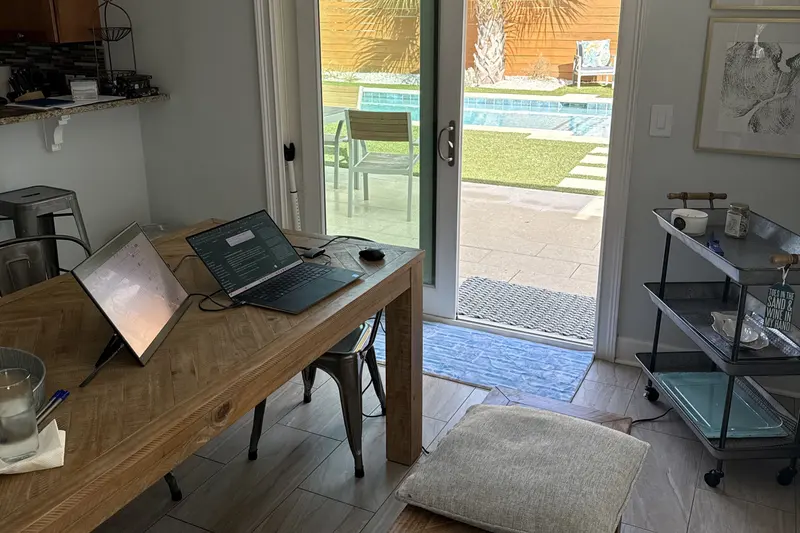
Can you get real work done from someone else's house? Kindred listings say whether a home has a workspace and what internet speed the host reports. Across my 8 completed stays with known listing details, 6 named a workspace or a standing desk.
Listed internet ranged from basic (under 25 Mbps, or megabits per second, on the Georgia coast) to over 500 Mbps. Those are the hosts' figures, not measured speeds.
Does your job depend on a video call? Then the sensible approach is to read the listing's work details, ask the host about the connection before you book, and bring backup connectivity anyway. Every stay, with what each listing said about work, is in every stay, with work notes. The kit that covers the gaps is in the setup that makes a swap workable.
Has the internet ever let me down? Not yet. The one listing that said basic internet (under 25 Mbps), a house on the salt marsh near Jekyll Island, turned out slow but totally fine: video calls and everything else worked, and I never needed my Starlink dish there. Everywhere else the internet was fine.
The bigger lesson was about where to sit. I almost never use the "workspace" a listing shows. It is usually a small desk in a corner, facing a wall. I work at the dining table, and I check the photos of the dining table before I book (and skip houses with a glass one). More on that in what I look for in a listing.
Which platform for a homeowner?
So which one fits you? In brief, as of November 2026, Kindred fits you if you own or rent a primary home and want credit-based stays, cleaning arranged per trip and fees paid per stay rather than a yearly membership.
HomeExchange fits you if you want the largest worldwide network, a flat annual fee and the option of reciprocal swaps. ThirdHome fits owners of a second home (often a high-end one) who want a vetted network of similar homes.
I earn Kindred credits if you join through my referral link, so weigh this accordingly. The comparison page tries to be fair, including when Kindred is the wrong choice: Kindred vs. HomeExchange vs. ThirdHome.
Who would I tell not to try it? People with really cluttered houses, people with too many unique valuables to put away somewhere secure, and anyone who just doesn't trust strangers around their things.
My record so far
I host from my home in the Atlanta area. As of November 2026 I have hosted 100 nights for 14 guests and completed 8 Kindred stays, 56 nights in total, since October 2025. The next is 13 nights in Tucson, AZ, booked for Dec 2026–Jan 2027.
| When | Where | Nights |
|---|---|---|
| Oct 2025 | Salt Lake City, UT, Sugar House | 3 |
| Nov 2025 | Coastal Georgia, Near Jekyll and St. Simons | 4 |
| Jan 2026 | St. Simons Island, GA, South end | 16 |
| Jan–Feb 2026 | Surf City, NC, Topsail Island | 7 |
| Apr 2026 | Islamorada, FL, Florida Keys | 8 |
| Jul 2026 | Philadelphia, PA, Washington Square West | 3 |
| Sep 2026 | Big Island, HI, Kohala Coast | 10 |
| Oct 2026 | Lake Lanier, GA, Gainesville | 5 |
| Dec 2026–Jan 2027 | Tucson, AZ (booked) | 13 |
Want each home, what its listing said about work and how it went? That is all in the stay log.
How I plan around Kindred
Because I work remotely and my schedule is flexible, I use Kindred in three ways.
- I plan my own trips on my own schedule, Kindred or not, and open those dates on my home. In many cases (not all) guests fill them in. People tend to look closer to the date than far ahead, so the bookings often arrive later in the process.
- I open long windows well in advance. I like getting out of Atlanta in winter, so I opened most of January and February. A couple living in Europe, who wanted their own place while visiting family in Atlanta, asked for nearly a month. That one booking earned me about 30 credits, which paid for my next two Kindred stays (16 nights on St. Simons Island and 7 in Surf City), and I visited friends for the rest.
- I browse the map for places I'd like to go, flag homes that appeal to me and set alerts for when they open up. If it is far enough ahead, I build the trip around the house. That is how I got ten nights in a home on the Big Island.
Planning ahead is the whole trick. You can't use Kindred like Airbnb and decide on a Tuesday to spend the weekend in a particular city. Most of the time you won't find a home, except perhaps in very large cities with lots of Kindred homes. If you can plan ahead and be flexible with your dates, there is a lot of availability, in really good locations.
About this guide
Field Office (fieldofficeguide.com) is a practical, first-person guide for experienced remote professionals who want to work from more interesting places, such as home swaps, ranger cabins, off-grid stays and the odd hotel, without their work setup falling apart. It is written by Kevin Luten, an Atlanta-based remote worker and Kindred home-swap host who has hosted 14 guests in his own home and completed 8 Kindred stays (56 nights) since October 2025, with a ninth booked. The site covers home swapping from the homeowner's side, a dependable remote-work setup (reaching a home computer from anywhere, off-grid power, Starlink and a travel kit) and paying for travel with points. Everything is based on Kevin's own stays and setup, and every referral link is disclosed.

About the author. Kevin Luten is a long-time remote worker and Kindred home-swap host based in Atlanta. He has hosted 14 guests in his home and works from home swaps, ranger cabins and the occasional hotel. He founded the behavioral-science consultancy Behavior Design Works, is a Cialdini Certified Practitioner, and has spent about 28 years in transportation demand management. He writes Field Office. More about Kevin.