The short answer
Add up your daily watt-hours (laptop, monitor and any connectivity gear), pick a portable power station (a big rechargeable battery with outlets and USB ports) with at least 20% headroom over that number, charge laptops over USB-C where you can because it avoids the energy lost converting to wall-style power, and add a solar panel big enough to put back what you use in a day of sun. In the worked example below, a laptop-and-monitor day comes to about 380 Wh with headroom. Add a Starlink Mini, the small dish for Starlink's satellite internet, and it climbs toward 750 Wh.
I'm Kevin Luten, and on Field Office I write about working from places like ranger cabins (rustic cabins the US Forest Service rents by the night) and a rooftop tent, where there is often no outlet at all. My off-grid power is a power station from EcoFlow's River series, charged by a solar panel from Goal Zero. Both are portable power brands.
Below is what I use, then the sizing method, so you can work out what you need rather than copying someone else's kit. Example numbers on this page are labeled as examples. They are not my measurements.
What I use
An EcoFlow RIVER Pro, which I bought in 2021, and a Goal Zero folding solar panel. The RIVER Pro is still working like a charm, and it is one of the best purchases I've made. It holds 720 Wh, takes up to 200 W of solar input, and weighs about 17 pounds, per EcoFlow's published specifications (EcoFlow has since replaced it with newer RIVER models).
I use it for all kinds of things. It runs my Starlink dish and the portable refrigerator I keep in my Jeep on most trips, and it charges just about everything else. It recharges from the car's 12-volt socket (the old cigarette lighter) or from the solar panel. The panel is a three-section Goal Zero that folds into one square and has a storage pocket, so it fits easily in the car.
I like the RIVER Pro for the same reasons I like my much smaller power bank: it feels solidly made, and the digital display shows exactly where you stand.
- EcoFlow RIVER series power stations
Affiliate link: I may earn a commission at no cost to you. - Goal Zero solar panel
Affiliate link: I may earn a commission at no cost to you.
How links here earn money: disclosures. These affiliate links don't go live until each program approves them.
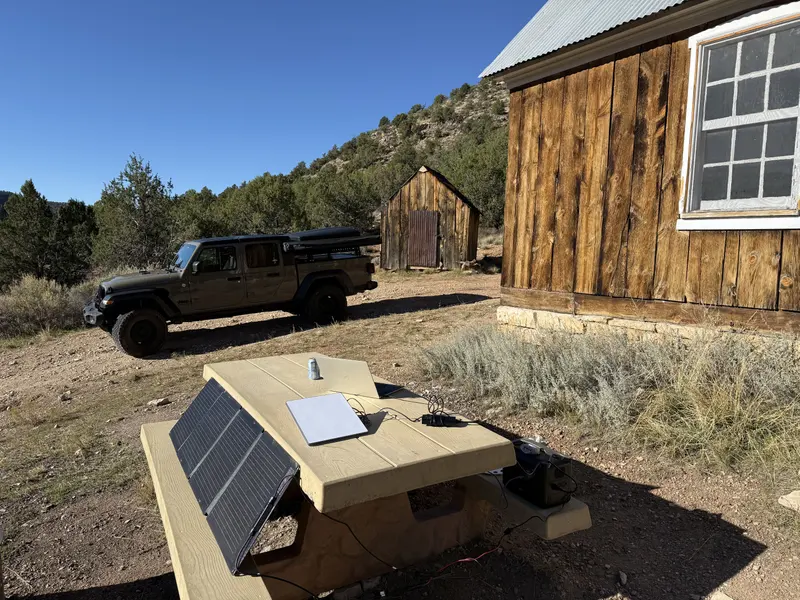
How do I size a power station for a workday?
Power stations are rated in watt-hours (Wh), which is how much energy they store. Your devices draw watts (W), which is how fast they use it. The sum is simple:
Daily Wh = for each device, watts × hours of use, added together.
Then allow for losses and headroom. The inverter is the part that turns the battery's DC power into wall-style AC, and it wastes some along the way. Running things through the station's AC outlet? Divide by about 0.85 to cover inverter losses (inverter efficiency varies by model). Then add 20% so you are not running the battery flat.
Finding the real wattage
The number on a laptop charger is its maximum, not what the laptop actually uses. A 100 W charger might feed a laptop that averages a third of that during ordinary work, and much more while it is charging from empty or rendering video.
So measure instead of guessing. An inexpensive USB-C power meter between charger and laptop shows live watts, and most power stations display current output on their screen. Watch it over a typical hour of work.
A worked example (example numbers, not mine)
| Device | Average watts (example) | Hours | Wh |
|---|---|---|---|
| Laptop, ordinary work | 30 | 8 | 240 |
| Portable monitor | 10 | 6 | 60 |
| Phone charging | — | — | 15 |
| Subtotal without Starlink | 315 | ||
| Starlink Mini (Starlink's published average is 25–40 W) | 30 | 8 | 240 |
| Subtotal with Starlink | 555 |
In this example, the laptop-only day needs about 315 Wh, or about 380 Wh with 20% headroom if everything charges over USB-C. The Starlink day needs about 555 Wh before losses. Run the dish from the AC outlet, add headroom, and it climbs toward 750 Wh.
That is the difference between a small station and a mid-size one. It is also why the connectivity question matters as much as the laptop, right?
Now fill in the same table with your own devices and hours. Starlink's own spec sheets list average power draw of 25–40 W for the Starlink Mini and 75–100 W for the Standard kit (checked November 14, 2026). More in Starlink's power draw.
My real numbers
Do I run out? Not if it's sunny. With the panel topping it up, the RIVER Pro keeps up, and I generally don't stay off-grid for more than two or three days anyway. I have come close a few times. My backup is the car: I start the engine and charge the station from the 12-volt socket.
How much does a solar panel actually give you?
A panel's rated watts are what it makes in ideal test conditions: full sun, square to the panel, cool temperatures. In the field, you get less. The angle drifts as the sun moves, heat reduces output, and haze, clouds and shade from trees cut it sharply. Even light shade across part of a panel can drop output a lot. Owners commonly report seeing well under the rating.
Hold on, my 100 W panel will not give me 100 W? Only in conditions close to the test.
So how much will you actually harvest in a day? A rough estimate: rated watts × hours of good sun × a real-world factor. As an example only, a 100 W panel, 5 hours of good sun and a factor of 0.6 gives about 300 Wh in a day. That would refill the laptop-only example above, but not the Starlink one. On a cloudy day, plan on a fraction of that, and keep a margin in the battery rather than counting on tomorrow's sun.
- Point the panel at the sun and re-aim it every couple of hours.
- Keep the power station in the shade while the panel sits in the sun, because batteries charge more slowly when hot.
- Check the connectors. Goal Zero panels and EcoFlow stations use different solar plugs, so you will usually need an adapter cable. Check that the panel's voltage is within the station's solar input range too.
Should I charge my laptop over USB-C or the AC outlet?
USB-C, where your laptop allows it. Why does it matter? A station's battery stores DC power. Using the AC outlet means converting DC to AC, then your laptop charger converts it back to DC, and you lose energy at both steps.
A direct USB-C Power Delivery connection (PD, the standard that lets USB-C carry laptop-level power) skips that. Most laptops charge over USB-C at up to 100 W, and newer USB-C PD 3.1 laptops and cables support up to 140 W or more. Check that the station's USB-C port is rated at least as high as your laptop's charger. If it is not, your laptop will charge slowly or fail to keep up under load.
What are other good options?
EcoFlow's River line is one of several. The main alternatives in this size range:
- Jackery Explorer: a long-running line of portable stations, from small to large.
- Anker Solix: Anker's power stations, sold alongside its power banks and solar panels.
- Bluetti: a wide range including expandable models with add-on batteries.
- EcoFlow Delta and larger EcoFlow units: more capacity and output, more weight.
Many current stations, including recent River models, use LiFePO4 (lithium iron phosphate) batteries, which tolerate many more charge cycles than older lithium-ion chemistries. Some also offer pass-through charging, so you can charge the station from the panel while it powers your laptop. What should you compare? Capacity in Wh, USB-C output wattage, solar input wattage and weight. For a laptop workday, those four matter more than peak AC output.
I have not tested these alternatives, so this is a list of where to look, not a ranking.
What mistakes should I avoid?
- Leaving the AC inverter switched on when nothing is plugged in. It draws power just being on and slowly drains the battery.
- Sizing from charger labels instead of measured draw, which usually overestimates the laptop and underestimates everything else.
- Forgetting the connectivity gear. A satellite dish can use as much as the laptop.
- Counting on full rated output from the panel, or on sun tomorrow.
- Planning to fly with it. Power stations this size are well over the 160 Wh limit for batteries in passenger baggage, so they travel by car.
Where I use this: ranger cabins, a rooftop tent and other places where I need off-grid power. The rest of what I carry is in the rest of the kit, and the full picture is in the setup.
Starlink power figures from Starlink's specification sheets, checked November 14, 2026. Other numbers on this page are labeled examples, not measurements.

About the author. Kevin Luten is a long-time remote worker and Kindred home-swap host based in Atlanta. He has hosted 14 guests in his home and works from home swaps, ranger cabins and the occasional hotel. He founded the behavioral-science consultancy Behavior Design Works, is a Cialdini Certified Practitioner, and has spent about 28 years in transportation demand management. He writes Field Office. More about Kevin.